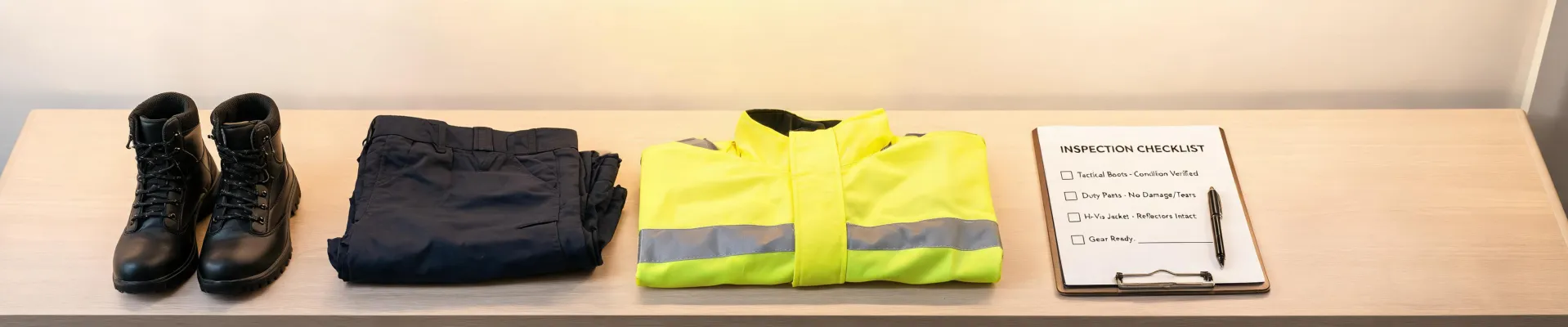
There isn't one 'best' 5.11 Tactical set-up. The right answer depends on the role, the client, and the site.
I manage purchasing for a security contracting company—about 200 employees across three locations. I process roughly 60–80 orders a year and handle annual spend of around $300k. I've made good buying calls and bad ones, and the bad ones were usually caused by buying a product before understanding the job. Below I'll walk through three scenarios that shape every tactical gear decision I make.
Why a Scenario Matters More Than a Product List
The common mistake is picking a brand and then trying to make every role fit that brand. That's backwards. Two people on my team may both work for the same company, but their gear shouldn't be identical if their days are different.
One spends the day in a client's office doing threat assessments. Another is outside a construction site, next to a fence company crew installing perimeter barriers. They have different tasks, different safety requirements, and different public visibility levels.
So here are the three scenarios I actually buy for: low-profile work, uniformed patrol, and site security.
Scenario 1: Low-Profile or Plainclothes Work
If your people need to look like they belong in an office or a hotel lobby, the gear has to disappear. A full backpack with MOLLE webbing screams 'armed operator' and can make clients uncomfortable. That's not a perception problem—it's an operational problem.
For low-profile assignments, I've been happy with the 5.11 Tactical LV10 Sling Pack. It sits close to the body, a jacket covers it without awkward adjustment, and it fits a radio, a trauma kit, a flashlight, and a power bank. For a quick trip to a client meeting or a vehicle inspection, it's the right size.
Here's the quality piece: when an officer walks into a client's building with a clean, quiet bag, the client reads that as preparation. It's not about looking expensive. It's about not looking like you're carrying a weapons system.
We learned the hard way to test before scaling. I knew we should order sample bags first. But the contract required 30 bags in two weeks, and I thought 'what are the odds the interior organizer is wrong?' Well, the odds caught up with me. The radio batteries didn't fit, and the zippers caught. A 15-minute sample test would have caught both issues.
If your load is bigger than LV10, look at the 5.11 Tactical Covrt18. It's still low-key, has 18 liters of capacity, and doesn't have that boxy 'tactical pack' silhouette. But don't trust the name alone; verify the dimensions against the gear your team will actually carry.
Scenario 2: Uniformed Patrol or Visible Security
Uniformed officers need durability, organization, and consistency. Consistency matters more than people think. When a client sees eight officers arrive with the same type of duty bag and organized loadouts, it says 'this company has its act together.' When they see mismatched backpacks and gear stuffed into plastic bags, it says the opposite. After we standardized our patrol bags, one client's feedback scores improved by 23%. I can't prove the bags were the only factor, but the timing lined up with how prepared the team looked.
For uniformed patrol, my baseline is the 5.11 Tactical Covrt18 as an administrative backpack. It carries a spare uniform shirt, a medical pouch, paperwork, and a change of boots without turning into a hiking bag. I also order the 5.11 Tactical LV10 Sling Pack for team leads who need radio access without taking off a full backpack.
One communication failure taught me to specify the details. We told the supplier it had to work with our radio system. They confirmed. When the product arrived, the internal pocket was sized for a different brand of radio. We were using the same words but meaning different things. Now every order starts with a physical sample and a checklist.
Is the higher-priced option worth it? Sometimes. For client-facing roles, yes—because the difference between a $70 bag and a $120 bag is often the hardware and stitching, not the logo. For warehouse-only positions, budget gear can be fine. Simple.
Scenario 3: Site Security, Construction, and Industrial Work
This is where I see buyers overcorrect. They buy a ballistic helmet for someone who is climbing over rebar and supervising a fence company installation. He doesn't need a ballistic helmet. He needs head protection that meets the standard and doesn't fall off when he looks up.
For site work, I've had better results with a Kask hard hat than with tactical helmets. Kask offers industrial helmets that are lighter, adjustable, and often more comfortable with radio earmuffs. The first time I outfitted a fence company's security detail, I almost bought tactical bump helmets because they looked the part. Looking back, that would have been wrong. The crew spent ten hours on their feet in the sun, and the Kask got worn. The expensive tactical helmet sat in the truck, which meant it was useless.
Per ANSI/ISEA Z89.1, Type II hard hats provide lateral impact protection. Verify current requirements at the ISEA website before you finalize a specification. If your procurement team asks for 'a hard hat' without a standard, they're setting you up for a failed inspection.
If the work involves razor-wire or perimeter fencing, add cut-resistant gloves and eye protection before spending more on another pack. It's not the most exciting purchase, but it's the one your operations manager will thank you for.
What About Handcuffs?
There's a search phrase that gets a lot of attention: 'how to escape handcuffs.' I'm not going to publish an escape guide, and neither should you. Standard restraints aren't a magic solution—they're a delay tactic. If your team is focused on escaping handcuffs, that's a sign you need more hands-on restraint training, not a different pair of cuffs.
What I do as a buyer: order cuffs and cases from approved vendors, verify they release smoothly, and schedule annual training with a certified instructor. Last year, an instructor showed us that a simple cuffing mistake was causing most of our transport delays. The fix was training, not a different handcuff.
If you choose 5.11 Tactical handcuff cases, make sure the retention mechanism fits your officers' duty belt setup. That's one of those 'the exact model matters' moments. Don't assume one-size-fits-all applies to restraints.
How to Tell Which Scenario You're In
If you're not sure, ask these three questions:
- Will the wearer be visually identifiable as security? If no, start with the LV10 Sling Pack.
- Does the role require more than a small medic/radio loadout? If yes, start with the Covrt18.
- Is there a site safety requirement for head protection? If yes, skip the tactical helmet and look at a Kask hard hat certified to ANSI/ISEA Z89.1.
During our 2024 vendor consolidation project, I cut the vendor list from eleven down to six, standardized soft goods through 5.11 and head protection through Kask, and cut our ordering time from three days to one. The key was standardizing by category, not by a single product. That's why we have both the LV10 and Covrt18 in inventory.
If the answer is still 'I don't know,' don't place a bulk order. Buy two or three options, have your most critical employees test them for a week, and then standardize around the one that works. The buyer who tests before buying ends up with a better fleet and a finance team that trusts the next request.
My experience is based on roughly 80 orders a year for a 200-person security operation in the U.S. If you're a federal agency or a one-person shop, your requirements may differ significantly. That's the point: there's no universal loadout, only the right gear for the job.
Bottom line: quality isn't about looking expensive. It's about not failing when a client is watching. A $50 difference per bag translates into noticeably better client retention when your team looks prepared and shows up without gear failures. Buy for the role, test before you scale, and let the scenario decide.