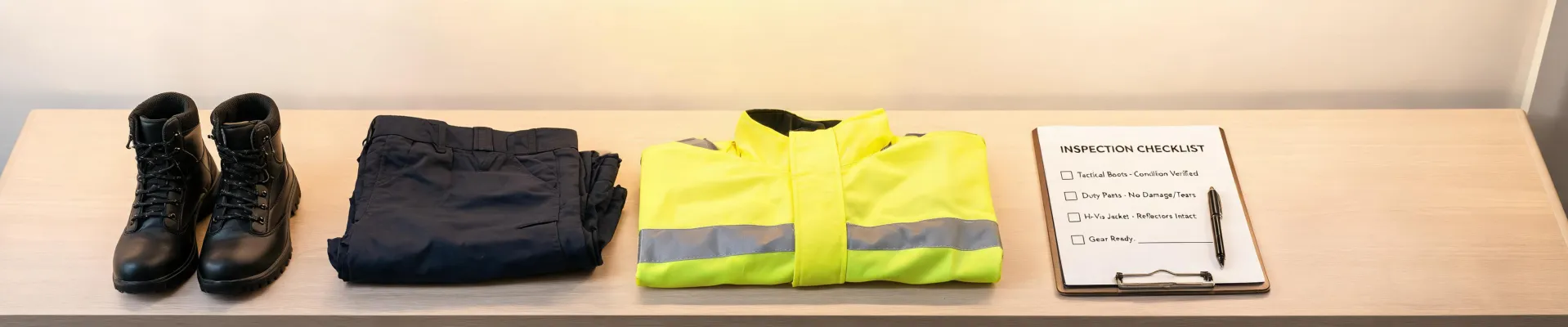
There's No One Way to Handle an Emergency Gear Order
Look, I've been coordinating equipment procurement for a mid-sized security firm for about six years now. In my role, I've handled over two hundred rush orders—everything from a single pair of boots needed by tomorrow morning to a full squad deployment kit that had to be complete in 72 hours. If you ask me, the single biggest mistake people make is treating every urgent order the same way.
The reality is, your approach depends heavily on what you're buying, who you're buying for, and how much time you actually have. Here's a more honest way to think about it—broken down by the three most common scenarios I've dealt with.
Scenario A: The Single-Item, Single-User Emergency
This is the classic situation. A client calls at 4:00 PM on a Tuesday. Their primary duty belt broke. Or their boots delaminated during a training exercise. They need one specific item by 7:00 AM the next day—in hand, not shipped.
What actually works
In March 2024, I had a client who tore the crotch seam on their 5.11 Stryke PDU pants 36 hours before a high-visibility operation. Normal turnaround from our usual distributor was four to five business days. We found a local retailer that stocked that exact model, paid $35 in gas and took the afternoon off to pick them up. Total cost: the pants at MSRP plus a tank of gas. Total time saved: days.
Here's the thing: for single-item emergencies, the fastest route is rarely the most digital one. Don't spend 20 minutes comparing shipping options. Pick up the phone and call every local retailer that carries the brand. If that fails, call the distributor directly and ask about rush processing. Some have Saturday pickup options you wouldn't know about unless you ask.
When this doesn't work: If you're in a rural area without local retailers, or if the item is highly specialized (like a specific NIJ-rated plate carrier), the local option falls apart. In that case, you're looking at overnight shipping, and you need to verify stock before you place the order.
Scenario B: The Full-Ready-Package Emergency
Now we're talking about a different beast. A client needs a complete, task-specific kit—uniform, boots, plate carrier, helmet, maybe even a fire extinguisher for a vehicle or facility—all on an expedited timeline. This is where things get complicated because you can't just run to five different stores.
I had a situation in Q3 2023 where a client was deploying a rapid response team on a 5-day notice. They needed four full sets of gear, including 5.11 tactical meridian photos for reference (which they sent me a screenshot of at 11 PM on a Sunday).
The budget trap
People think the biggest cost in a rush order is the price of expedited shipping. Actually, the biggest cost is getting the spec wrong and having to reorder. I've seen it happen: a vendor promises a 48-hour turnaround, ships the wrong size plate carrier, and then you're stuck with a $1,200 mistake and 36 hours to fix it.
For a full-package emergency, my advice is counterintuitive: slow down your decision-making to speed up delivery. Spend the first 30 minutes triple-checking the spec, the sizes, and the exact SKU numbers. One wrong click can cost you two days and $800 in restocking fees. In my experience, the rush fee on a correctly ordered item is rarely more than 10-20% of the base cost. The rush fee on a returned item is 100% of the base cost plus lost time.
What I recommend
For full-kit emergencies, use a vendor that already has a relationship with the brand—like a certified 5.11 dealer. They can often pull from multiple warehouses and consolidate an order faster than any marketplace algorithm. Between you and me, I've had better luck calling a sales rep directly than using any "rush shipping" button on a website.
When this doesn't work: If you're trying to outfit a large team (more than 10 people), a true "emergency" turnaround on full kits is almost always a bad idea. You're better off splitting the order: critical items (boots, plates) via rush, non-critical items (pouches, accessories) via standard. That's the compromise I've used on multiple occasions, and it usually saves 30-40% on total rush costs.
Scenario C: The Unprepared Bulk Order
This one's less dramatic but more common. You need, say, 50 pairs of 5.11 tactical duty ready plus crew socks and a dozen handheld extinguishers for a facility—and you needed them last week. There's no single event driving the urgency; it's just poor planning or a surprise inspection.
In 2022, our company lost a $15,000 contract because we couldn't provide proof of in-stock fire extinguishers at a client site. The client gave us 72 hours to show compliance. We scrambled, found a regional supplier that over nighted the extinguishers, and paid $600 in expedite fees—but we saved the contract.
The myth of "rush everything"
The assumption is that rush ordering is always worth it for compliance deadlines. I'd argue the opposite: for bulk non-critical items, you're often better off splitting your order. Rush 20% of the stock to meet the bare minimum requirement, then place the remaining 80% on standard delivery. We used this strategy last quarter for a large security uniform refresh project. It lowered our total rush cost by nearly 60%, and it didn't break the client's budget.
When this doesn't work: If you're under a regulatory deadline (like OSHA or fire code) that requires 100% compliance, splitting isn't an option. But for most internal deadlines, it's a viable hack that most procurement people I know use.
How to Figure Out Which Scenario You're Actually In
Here's the decision tree I use—and it's not complicated. Ask yourself three questions:
- How many items? One item? Go local. Multiple items? Go to a certified dealer. Team quantity? Consider splitting.
- What's the consequence of missing the deadline? If it's a compliance fail or a client penalty, rush costs are usually justified. If it's just inconvenience, standard shipping is fine.
- Do you have a trusted vendor already? If not, don't try to build a relationship during an emergency. Use an established dealer or a direct brand channel.
I'm not saying this is a perfect system. My experience is based on about 200 orders with mid-sized security and public safety clients. If you're working with an individual officer and a single purchase order, your experience might differ—but these three scenarios cover the vast majority of urgent gear requests I've seen. The key is to stop treating every emergency the same, and start asking the right questions before you place the order.
