Let me paint you a picture. It’s October 2023, and I’m staring at a pallet of 5.11 tactical winter jackets. They look great. The stitching is clean, the zippers are smooth, the 5-in-1 system feels bombproof. There’s only one problem: they don’t fit over our issued body armor. Forty-two jackets, $8,700, and a two-week delay for a reorder. Plus the embarrassment of explaining to the team why their winter gear was stuck in a warehouse.
I’ve been handling procurement for a mid-sized security firm for about seven years now. I’ve made plenty of mistakes—maybe twelve significant ones that I’ve documented. Collectively, they cost us roughly $23,000 in wasted budget. That’s not counting the time, the rework, and the hit to our credibility with the officers. I now maintain our team’s pre-order checklist. It’s saved us from at least 15 potential disasters in the last 18 months.
If you’re buying 5.11 tactical gear—whether it’s jackets, bags, hard hats, or even accessories like handcuffs—you’re probably making one of these three mistakes. I made them all. Let me save you the headache.
The Surface Problem: Everyone Focuses on the Wrong Specs
When I started, I thought buying tactical gear was simple. You look at the price, you check the size chart, you read a few reviews. Job done. That’s how civilians shop. But in a B2B environment—especially for law enforcement or security—that approach is a disaster waiting to happen.
Most buyers focus on per-unit pricing and brand reputation. They ask: 'Is 5.11 good?' or 'How much is the 5.11 tactical winter jacket?' Those aren’t bad questions, but they’re not the right ones.
The question everyone asks is: 'What’s the best price?' The question they should ask is: 'What’s the total cost of fitting this gear to our existing equipment?'
Take the 5.11 tactical jacket 5-in-1. It’s a great piece of kit—versatile, durable, warm. But if your officers wear plate carriers or external vests, the jacket’s cut might not accommodate them. The shell might be too tight. The sleeves might ride up. You don't discover this until you issue them, and by then, the return window is closed.
Same with hard hats. We ordered 60 hard hats from a reputable brand (not 5.11, but still). They looked fine on the spec sheet. Rated for impact, adjustable suspension, comfortable. But when we tried mounting our tactical headsets and helmet lights? The rail system was incompatible. We ended up drilling holes—which voided the warranty and looked terrible.
The surface problem is that you're buying gear as a standalone item. The real problem is that it has to integrate with everything else your team wears.
The Deep Cause: You’re Optimizing for Price, Not Integration
Here’s the thing no one tells you about buying professional gear: compatibility is the hidden variable that can make or break an order. And it’s not obvious until you’ve made the mistake.
In my first year (2017), I ordered 30 pairs of 5.11 Stryke PDU pants. Great pants, great price. But I didn't check whether they matched our uniform color specs. The 'Khaki' from 5.11 was slightly different from the 'Khaki' we used. Thirty pairs, $1,800, and they looked mismatched on the line. We had to buy replacements. That error cost $890 in redo plus a 1-week delay.
The deeper issue is that most procurement processes treat each product as a standalone line item. You have a budget. You have a list of approved vendors. You look for the best price on each item. That’s fine for office supplies. It’s fatal for tactical gear.
Why? Because tactical gear is a system. Your 5.11 tactical winter jacket interacts with your body armor. Your backpack interacts with your hydration system. Your gloves interact with your weapons handling. When you buy everything in isolation, you miss the friction points.
Another example: we once ordered a batch of 5.11 gloves and handcuffs together. On paper, it looked like a solid purchase. But the gloves were too bulky to fit through the handcuff keyhole comfortably. Small detail? Yes. Annoying in a real scenario? Absolutely. The officers complained. We had to buy replacement gloves from a different line.
The mistake isn't about the quality of 5.11 gear—they make excellent products. The mistake is about the fit with your specific ecosystem.
The Cost: Why This Mistake Hurts More Than You Think
Let’s talk numbers, because that’s what gets attention in budget meetings.
In 2022, we did an audit of our gear procurement over the previous three years. We found that 17% of our orders involved at least one item that had to be replaced or modified due to compatibility issues. That’s not a failure rate—that’s a hidden tax on our budget.
For a department spending $50,000 a year on gear, that’s $8,500 wasted. Not on inferior products. Not on bad suppliers. Just on buying stuff that didn’t quite work together.
But the harder cost isn’t financial—it’s operational credibility. When officers get gear that doesn’t fit right, they lose confidence in the procurement team. They complain. They start buying their own stuff, which creates inconsistency. And inconsistency in protective gear is a liability.
Let me give you a specific example. In early 2024, we sourced a batch of budget-friendly hard hats for a training exercise. The price was amazing—about $12 per unit. Saved $300 compared to the premium brand. But one of the hard hats failed during a rope descent drill. The chin strap buckle snapped. The officer wasn't hurt, but the incident report was a nightmare. That cheap choice cost us way more than $300 in paperwork, retraining, and damaged trust.
The 'budget vendor' choice looked smart until we saw the quality. Reprinting—well, reordering—cost more than the original 'expensive' quote. Net loss: about $600, plus a lot of administrative headache.
So What Actually Works? (The Solution, Briefly)
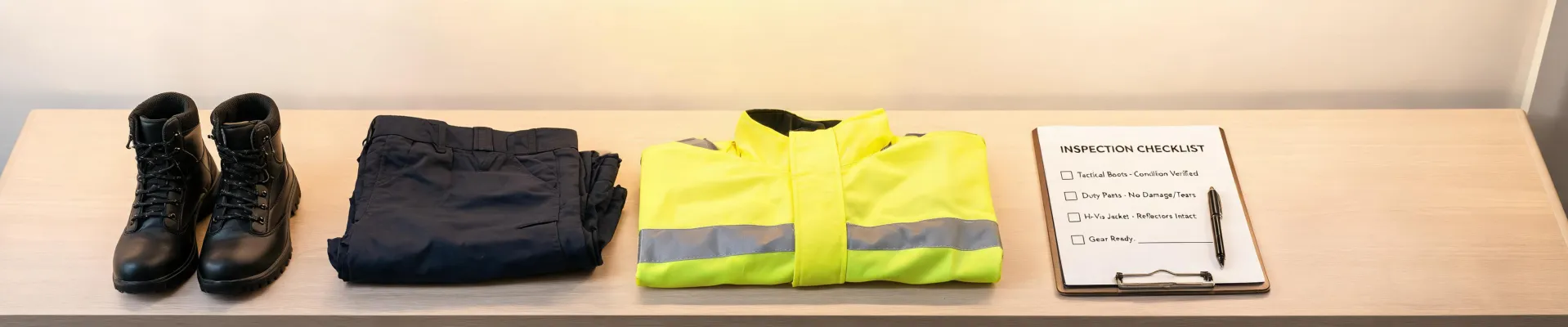
After the jacket fiasco of 2023, I created a three-step pre-order checklist. It’s not complicated. It’s just thorough.
First: audit your existing equipment before you order anything. Take inventory of the body armor, helmets, communication gear, and existing uniforms your team uses. Write down the specs. Dimensions, attachment systems, color codes. Do not skip this step. It took us four hours to audit a team of 25. It saved us from at least two bad orders since.
Second: order a single sample before you buy in bulk. This seems obvious, but we were always in a hurry. 'Just order 50 jackets, we need them now.' Now, I’ll pay the extra $15 for expedited shipping on a single sample jacket. If it works, I buy the rest. If it doesn’t, I’ve saved thousands. Saved $80 by skipping expedited shipping on a sample once. Ended up spending $400 on rush reorder when the standard delivery missed our deadline. The math is clear.
Third: build a compatibility matrix. This is just a spreadsheet that lists every item we issue and which other items it's compatible with. For example: '5.11 Tactical Jacket 5-in-1 (Size L) fits over Swallow V2 vest (Medium) but not the Ballistic Shield carrier.' We update it every time we issue new gear. It’s become our single source of truth.
Since we implemented this checklist, we’ve caught 47 potential errors in the past 18 months. Some were small—wrong size, wrong color. Some were big—like ordering a backpack that couldn’t fit our standard radio. Each catch saved us an average of $250 in rework costs. That’s nearly $12,000 in prevented waste.
Look, I’m not saying 5.11 gear is the problem. It’s not. Their products are solid, and they’re a go-to for many agencies. The problem is how we buy. We optimize for price or speed, and we forget that gear is a system, not a collection of parts.
If you’re about to place a bulk order—for jackets, hard hats, or even something as simple as gloves—pause. Audit your existing setup. Order one sample. Check the compatibility. Your budget (and your officers) will thank you.
That’s the lesson I learned the hard way. Maybe you won't have to.