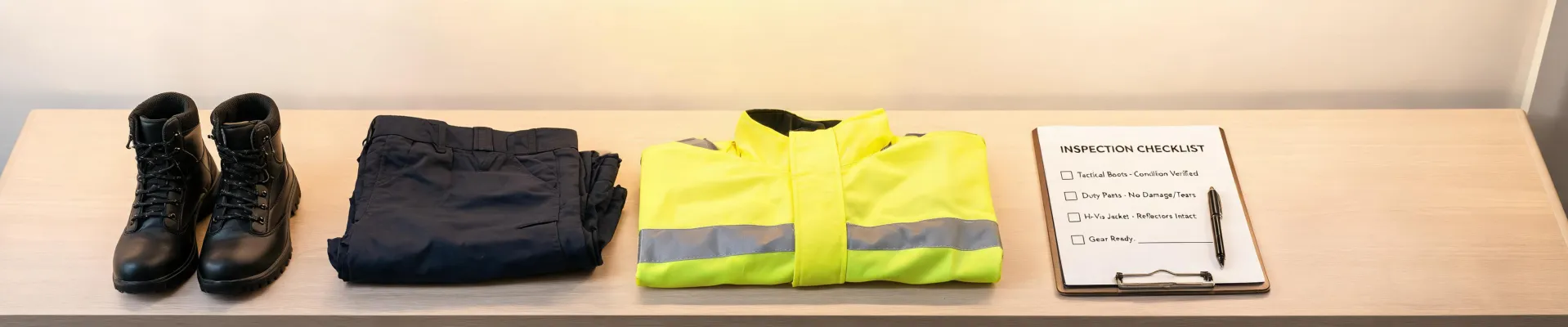
I'm a quality and compliance manager for a company that specs and outfits public safety, security, and facilities teams. Before any product goes into rotation, I review it—roughly 4,000 items a year, from tactical pants to hard hats and medical kits. I've rejected about 12% of first deliveries in 2024 due to spec mismatches, missing safety certifications, or stitching that didn't survive a single wash cycle. Since I implemented our verification protocol in 2022, we've caught more issues before they reached the field, not after.
So: is there a single 'best' gear list? No. Basically, the job determines the gear. Different roles face different risks. Trying to buy one ideal loadout for every person in your organization is a mistake. This guide is structured around three common scenarios, because the right answer depends on which one you actually live in.
When I first started reviewing tactical gear, I assumed that 'tactical' meant 'better in every situation.' Then a batch of rugged-looking pants failed at the seam after 90 days of normal duty. They weren't 5.11, but that's not the point. The point is that labels don't hold up to ladders, holsters, or kneeling on concrete.
First, Figure Out Which Situation You're In
Before you buy anything, sort your work into one of three buckets.
- Duty and active physical risk. You carry a weapon, make contact with hostile people, work in protective details, or respond to force. Fit, retention, and freedom of movement matter most.
- On-site and facility exposure. You climb ladders, walk through machine shops, work around forklifts, or manage construction sites. Head protection and foot protection matter most.
- Medical oversight and team readiness. You're responsible for first aid supplies, emergency response bags, and making sure other people can act before EMS arrives.
These overlap. But the priority order is different. Trying to satisfy all three at once usually ends with a jacket that's too heavy, a first aid kit that's too weak, and boots that nobody can stand in for eight hours.
Scenario 1: Duty Roles - 5.11 Tactical Pants and Velcro Belts
If you're in the first bucket, your pants and belt are load-bearing equipment, not just uniform items. This is where 5.11 Tactical usually comes up—and for good reason. Their lineup covers the full range from tactical clothing to duty belts, and they design with fieldwork in mind.
Take the 5.11 tactical pants slim fit. It's popular among officers who don't want a baggy silhouette. The slimmer leg cuts wind resistance and keeps fabric from catching around vehicle consoles. I assumed a slim cut would restrict movement. It doesn't, but it does run a half size tight in the thigh for a lot of people. In our Q1 2024 audit, we measured 120 pairs of 5.11 Tactical pants across six styles. About one in five testers said the slim fit felt tight through the thigh. So order true to waist size, but expect to size up if you have strong legs. Buy from a vendor with easy returns.
We've checked maybe 400 pairs of tactical pants over the past four years—or rather, 120 were measured in that audit, and the rest were visually inspected and stress-tested. The 5.11 material held up well in our seam-pull tests. That doesn't mean every style works for every body. It means the baseline is solid.
Now for the belt. I used to think a velcro belt was a compromise, a way to avoid choosing the right size. After two months of testing, I changed my mind. The 5.11 tactical belt velcro version works because it doesn't put a buckle between your abdomen and your holster. It adjusts in seconds, and it doesn't lose grip the way cheap closures do. We tested 12 belts last year—maybe 14, I'd have to check the report—and a few no-name velcro belts lost most of their stiffness after six months. The 5.11 belt was still holding its shape. But again, it's only worth the price if you're carrying actual gear on it. If you're an access control guard with a radio and a flashlight, a regular belt is enough.
The common mistake is buying 'tactical' gear for a job that isn't tactical. A security guard doing access control doesn't need a load-bearing vest. They need a presentable uniform, a good flashlight, and comfortable shoes.
Scenario 2: On-Site Roles - Studson Hard Hats and Amazon Safety Shoes
If your day is all about falling objects, slippery floors, heavy machinery, and chemical exposure, the priorities shift. You need impact protection first, and tactical-looking gear won't help when a wrench drops from six feet up.
Take the Studson hard hat. It's a lightweight, budget-friendly shell that a lot of contractors use for visitors and low-hazard areas. But 'budget-friendly' doesn't mean 'any hard hat is okay.' You need to see the ANSI Z89.1 rating printed on the shell. Actually, you need to see the exact rating. Type I protects against top impact; Type II also protects against side impact. Some cheap hats on online marketplaces don't have any standard printed at all. In 2024, we rejected a batch of 'hard' hats because the seller labelled them as 'decorative.' If you have to argue about whether a hard hat is real, it's not the right product.
And what about Amazon safety shoes? I have mixed feelings. On one hand, the convenience and review volume are hard to beat. On the other hand, the same marketplace is full of counterfeits and gray-market imports. Some listings look identical to high-end boots but have soft toe caps and glued soles. Search 'amazon safety shoes' and you'll see prices from $25 to over $200, based on listings we pulled in March 2025. For a one-time site visit, a $30 pair with the ASTM F2413 marking inside might be fine. For 40 hours a week on concrete, spend more. Wear them for a week before you trust them.
Scenario 3: Team Readiness - What Is in a First Aid Kit?
The third scenario is less glamorous but often more important. Every work area legally needs a first aid kit, but the contents differ based on the actual risks. So what is in a first aid kit that you don't just hang on the wall and forget?
For a 10-person team in a low-hazard facility, the baseline is simple: nitrile gloves, trauma shears, adhesive bandages in assorted sizes, sterile gauze pads, medical tape, antiseptic wipes, a CPR mask, and a cooling pad. That's the floor. If your site has higher risk—machinery, heat stress, extended EMS response times—or if you're covered by OSHA's medical response rule, expand it.
For higher-risk environments, add an Israeli bandage, a tourniquet, chest seals, and a compact emergency blanket. The industry has shifted toward hemorrhage control over the past five years. What was best practice in 2020 may not apply in 2025. The fundamentals haven't changed: stop bleeding, protect the wound, support breathing. But the gear has evolved.
I learned this the hard way. We once bought pre-made 'tactical' first aid kits for a facility of 40 people. They looked impressive. When we opened them, the bandages were cheap, and the adhesive had dried out after sitting in a hot storage room. We rebuilt all of them. Now every kit we approve has a documented contents list and an expiration-check date. If a kit doesn't list expiration dates, treat it as suspicious.
How to Know Which Scenario Applies to You
The easiest way to decide is to ask three questions.
- Do you expect physical confrontation? If yes, start with duty gear: a well-fitted 5.11 Tactical pant, a belt that will hold a holster without pinching, and boots that move with you.
- Do you work around impact hazards? If yes, the most important purchases are an ANSI-rated hard hat and safety shoes with an ASTM marking. Not another 'tactical' jacket.
- Are you responsible for other people's safety? If yes, focus on medical readiness. Build a first aid kit around the injuries you're most likely to see, and check expiration dates twice a year.
Still not sure? Start with the middle ground. A pair of 5.11 tactical pants, a simple belt, an ANSI-rated hard hat, and a first aid kit with real trauma components will cover a surprising number of situations. But don't stop there. Read the certification label. Buy from an authorized dealer. Write down the spec before you spend.
The gear industry is in the middle of a change. More brands are selling direct, more products are knockoffs, and more certification marks are being faked. In the past, you could trust a retailer's catalog. Now you need to verify. But that doesn't mean gear is worse—in many ways, it's better. The fundamentals haven't changed. The execution has transformed. And that's actually a good thing.