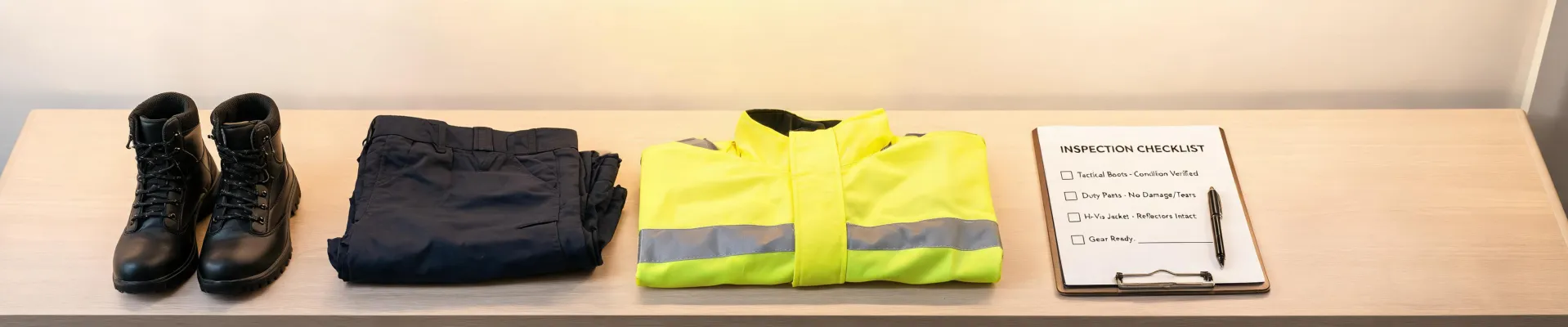
- Step 1: Separate 'Mission Critical' From 'Nice to Have'
- Step 2: Build a 'Per-Slot' Cost, Not a 'Per-Item' Cost
-
Step 3: Add the 'Hidden Setup' Fee to Everything
- Step 4: The 'Budget Trap' Test for Every Bulk Order
- Step 5: Run the 'Expensive vs. Cheap' Procurement Channel Comparison
-
Step 6: Always Ask 'Who Does the Disposal?'
-
Step 7: Build the 'Replacement Reserve' Into the Annual Budget
-
Three Common Mistakes to Avoid
When I first started managing our unit's equipment orders for a 40-person security company, I assumed the smartest move was to buy the cheapest tactical shirt on the market. I'd find a $25 5.11 tactical short sleeve shirt knockoff and think I'd saved the budget. Six months and three durability failures later—one of which happened during a client inspection—I'd spent more on replacements and lost more in credibility than if I'd just bought the real thing from the start.
This guide is for procurement managers, security directors, and operations leads who need to outfit a team without the finance director asking uncomfortable questions at the quarterly review. It's a checklist I've refined over tracking $180,000 in cumulative equipment spending across 6 years. It won't make 5.11 gear cheap. It'll make sure every dollar you spend actually shows up on the job.
Step 1: Separate 'Mission Critical' From 'Nice to Have'
Before you open any catalog, grab your last two incident reports and your post-shift debriefs from the past 90 days.
Ask yourself: what equipment failures or shortages directly impacted performance?
I made this mistake badly in 2022. I allocated 60% of our Q1 budget to upgrading everyone to the 5.11 tactical rush moab 3 sling pack 4l—a great pack, don't get me wrong—when what we actually needed was better footwear after two guys blew out their boots mid-shift. The packs looked professional. The boots would have prevented injury.
Your checklist here:
- List equipment that failed or caused a safety issue in the last 90 days
- Rank by: risk severity if it fails again
- Rank by: frequency of use
- Buy for the high-risk, high-frequency items first. Everything else is Phase 2.
Step 2: Build a 'Per-Slot' Cost, Not a 'Per-Item' Cost
Here's where I see most buyers trip up. They look at the unit price and stop.
Let's say a 5.11 tactical short sleeve shirt runs $65 USD. A competing brand's tactical shirt runs $35. The $35 shirt looks like the budget win, right? Not necessarily. You have to calculate the cost per usable shift. I tracked this over 18 months for our team. The $35 shirt lasted about 40 washes before fading or fraying. The $65 5.11 shirt lasted 120. That's $0.54 per shift for the cheaper shirt versus $0.54 for the name brand. Identical cost per use. And the 5.11 never had a pocket seam pop during a client-facing event.
The real cost—or rather, the real savings—comes from not having to replace gear mid-cycle.
Quick rule:
If the gear will be worn or used five days a week, calculate cost-per-day over 18 months. The cheaper option almost always loses.
Step 3: Add the 'Hidden Setup' Fee to Everything
I'm not talking about vendor setup fees (though watch out for those too). I'm talking about the internal cost of issuing gear.
When you buy a safety vest for a new hire, it's not a $40 transaction. Someone has to order it, receive it, log it into inventory, test the fit, train the employee on proper use, and track the disposal date for compliance. I calculated our internal setup cost at $18 per item—mostly in administrative time and training. That changed the math on a lot of my purchasing decisions. Suddenly, buying gear that lasts twice as long saves double the setup overhead.
For example: a $100 fire extinguisher cabinet that lasts 10 years requires one $18 setup. A $45 cabinet that starts rusting in year 3 requires a replacement and a second $18 setup. Now the cheap cabinet costs $63 more over its lifecycle. (Should mention: this assumes a stable team size, which is its own assumption worth checking.)
Step 4: The 'Budget Trap' Test for Every Bulk Order
I knew I should always check the discharge date on any fire extinguisher we bought, but thought 'what are the odds a unit from a reputable vendor would be close to expiring?' Well, the odds caught up with me when I received a pallet of extinguishers that had been sitting in a distributor's warehouse for 18 months. They still had 5 of 6 years of service life left, but the budget had been allocated for the current year. I had to explain a $1,200 reorder of fresh units in Q3.
What to check before you order in bulk:
- Manufacturing date (for extinguishers, helmets, body armor—anything with a shelf life)
- Industry compliance date (some models get certified against an older standard; you don't want stock that's already borderline obsolete)
- Vendor's inventory age (ask: 'How long has this batch been in your warehouse?' )
Step 5: Run the 'Expensive vs. Cheap' Procurement Channel Comparison
This is the step I almost never see on a standard buyer's checklist. Cost of acquisition matters.
In 2023, I compared costs across 6 vendors for a standard team equipment refresh. Vendor A (online retailer) quoted $2,300 for the full order. Vendor B (5.11 authorized distributor) quoted a contract price of $2,150 for the same items. I almost went with Vendor A because the interface was easier. Then I calculated TCO including shipping: Vendor A charged $480 for freight to our location—it was 80lbs of gear. Vendor B's freight was $120. Total difference: $2,780 vs. $2,270. That's a 22% difference hidden in line-item shipping.
Checklist for vendor comparison:
- Line-item freight cost (never accept 'standard shipping')
- Order minimums for wholesale pricing
- Restocking fees on returns (essential for fit issues with boots or plate carriers)
- Net-30 vs. prepay terms (cash flow value counts)
Step 6: Always Ask 'Who Does the Disposal?'
No one budgets for how to get rid of a fire extinguisher. We ordered 12 new units for the building, and the old ones—still under pressure, technically hazardous waste—couldn't just go in the dumpster. The local disposal service charged $25 per unit for pickup and recycling. That was an unbudgeted $300. If I'd known, I would have factored it into the replacement cost and shopped for a vendor that offered a take-back program.
This applies to: body armor, old duty belts, expired chem lights, and anything with a pressure vessel. Ask your vendor before you buy. If they say 'check your local regulations,' that means they won't help. Factor in $15-$30 per unit for disposal, or choose a vendor that does.
Step 7: Build the 'Replacement Reserve' Into the Annual Budget
This isn't sexy, but it's the step that stops the Q4 panic buy. My rule: every piece of soft gear (uniforms, gloves, packs, vests) has a 24-month replacement horizon. Hard gear (helmets, plates, tactical rush moab 3 sling pack 4l) gets 48-60 months. Each year, set aside 50% of the replacement cost for the items that will expire in the following 12 months.
Here's how I did it in our 2024 budget: I listed every item we'd need to replace by June 2025, got current pricing from the 5.11 distributor, and requested 25% of that total as a 'gear reserve' line item. It passed. Now I don't have to scramble when a boot blows out or an extinguisher hits its expiration.
I recommend this approach for teams of 10-100 people. If you're a smaller team (under 5), the reserve model might be overkill—you can probably buy as you need. If you're larger than 200, your procurement system likely already handles this. This sweet spot is where most mid-size security and tactical teams operate.
Three Common Mistakes to Avoid
1. Assuming 'Contract Pricing' Means Best Pricing
I assumed our volume contract with one distributor guaranteed the lowest price. Didn't verify against a second. Turned out their 'net-30' pricing was 8% higher than another authorized dealer's cash price. I switched—and saved $1,200 annually. Always get two quotes, even if you have a preferred vendor.
2. Ignoring the Fit Factor
Every tactical shirt and boot fits differently. I ordered 20 pairs of a specific 5.11 boot based on materials spec alone. Had to return 8 for size variance. That cost $160 in return shipping + restocking fees. Now I order a sample size run for 3 guys first. (Should mention: if you have a known size distribution from prior orders, your sample size can be smaller—but never skip it.)
3. Forgetting the Storage Cost
Bulk buying saves per-unit cost, but if you have limited storage—like a small equipment locker—you're paying to store gear that's not in use. That's a real cost. Calculate the square footage cost of gear storage per year. If it's high, buy more frequently in smaller batches.
No checklist will make gear cheap. But this one will make sure you don't pay for the same mistake twice. I've been doing this for 6 years, and the only rule that never failed me: the money you save by cutting corners is always less than the money you lose when the corner cuts you.