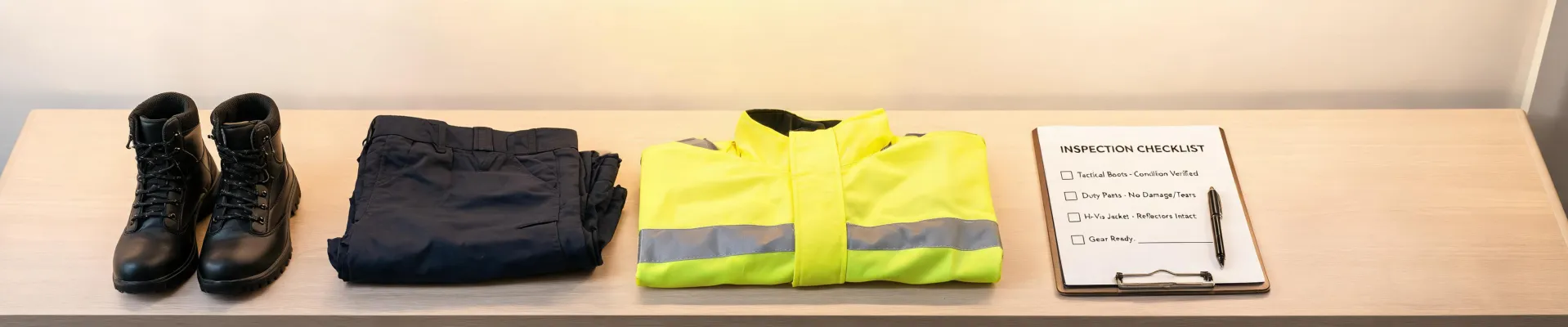
I'll say it plainly: cheap tactical gear is the most expensive gear you'll ever buy.
I've managed procurement for a mid-sized security operations company for six years. Roughly $180,000 in cumulative spending on tactical equipment—bags, duty gear, restraints, hard hats, PPE. Every order logged. Every failure documented. The pattern is unambiguous.
The industry has evolved massively since 2019. Gear that was "good enough" five years ago has been replaced by safer, stronger, smarter options. But purchasing habits haven't kept up. Most buyers—including me, for longer than I'd like to admit—still default to the lowest bid. That habit is costing companies real money. I have the spreadsheet to prove it.
Every year, I sit down with our operations manager and walk through the equipment failure log. The failures are almost never in the expensive stuff. They cluster in the budget buys. That's not a coincidence; it's a pattern with a cause. Cheap gear isn't cheap—it's pre-paid twice.
I didn't start out this opinionated. I was trained the standard way: get three quotes, pick the lowest, hope for the best. It took two costly failures to change my approach. This is what I learned.
The Backpack That Changed How I Compare Prices
Early last year, our field team needed new patrol bags. I was comparing the 5.11 Tactical RUSH MOAB 6 against a no-name bag at roughly half the price. On paper, they looked almost identical: similar capacity, similar molle webbing, similar velcro panel. I assumed "same specifications" meant comparable quality. Didn't verify.
Turns out, specs on paper don't tell you about stitching tension, fabric weight, or zipper rails. We'd been burned by a similar budget bag back in 2021—two zippers separated within four months, and one bag's bottom seam gave out during a training drill. A lesson learned the hard way. So this time, I ran the numbers properly.
Six cheap bags at $42 each: $252 upfront. Then the replacement cycle: $310 in re-purchases, re-issuing, and lost equipment. Total: $562. Six 5.11 RUSH MOAB 6 bags at $109.95 each: $659.70. The "expensive" option costs $97 more and comes with proven materials, solid stitching, and a warranty. The cheap option came with three frustrated officers and paperwork I didn't want to fill out again.
The MOAB 6's internal organization is genuinely well thought out—dedicated pockets keep our officers' extra mags, cuffs, and flashlight from rattling into one pile. The cheap bag had one main compartment and a vague "admin" slot that was too small for anything. That design difference doesn't show up in a spec sheet, but it shows up in every operational use.
Three years earlier, I would have stopped at the $252 price tag and celebrated the savings. That's how many buyers think: upfront savings, no follow-through. It took a line-item autopsy of our 2022 spending to see the failure costs hiding under "miscellaneous."
Worse than expected, honestly. And entirely avoidable.
Safety Standards Aren't Static—Hard Hats and Welding Helmets Prove It
The same logic applies to safety equipment, where the stakes are higher than repair costs. Take the white hard hat. We bought a batch from the cheapest supplier at $8 apiece. A hard hat is a hard hat, right? That's the old mindset. The head protection industry has moved on.
The basic hats still meet ANSI Z89.1 Type I requirements for top-impact protection. To be fair, they're not unsafe—they meet the minimum. But Type II designs add lateral impact protection, which matters for our people working around vehicle bays, low pipes, and overhead racks. The price gap is about $6 per hat. One avoided head injury pays for that difference a hundred times over. We've since phased in Type II hats as old inventory wears out—no special budget request, just a line-item swap that justifies itself.
Welding helmets follow the same curve. Our maintenance shop used to run with basic passive helmets—fixed dark lenses that force the welder to flip the hood down before striking an arc. It's a rhythm that works, until it doesn't.
For anyone wondering how a welding helmet works: a passive helmet is literally dark glass. An auto-darkening helmet uses UV/IR sensors to detect the arc flash and triggers a liquid crystal filter that shifts from light to dark in milliseconds—quality units in about 1/25,000 of a second. The welder keeps the hood down, sees the joint clearly, and strikes the arc without guessing blind.
In 2023, one of our "budget" helmets failed mid-weld. A bad bead, a two-hour redo, $180 in labor and materials. The helmet cost $45. The rework alone was worth four replacement helmets. There's a real resistance to paying $160 for a welding helmet when a $45 one does the same job—until it doesn't.
What was a premium feature in 2019 is now standard on mid-tier helmets. The auto-darkening technology got cheaper and faster over the past five years, which is exactly why buying a passive helmet today feels like buying a flip phone. It works, but paying for dated tech is its own hidden cost.
Field Truths: Restraints, Headwear, and the Details That Matter
Some failures are quieter, but they still cost money. Fuzzy handcuffs are a prime example—the foam-padded restraints used during transport. We bought a budget batch that looked perfectly acceptable on day one. By week three, the fabric was peeling and the padding had bunched up around the wrist cuff. Worse than the wear was the message it sent: if our gear looks like it fell apart in a drawer, what does that say about our standards?
We switched to a dedicated restraint manufacturer and never had a similar issue. I knew I should have tested them before ordering the full quantity. I thought, "what are the odds they fail?" The odds caught up with us.
Then there's the 5.11 Tactical Boonie Hat in Multicam. I'd read the reviews—most users mentioned the Multicam pattern and the build quality—but I wasn't expecting much. It's a hat. How much can a hat matter? I ordered six as a field trial for our outdoor checkpoint team in June 2024. The Multicam pattern blends into natural terrain far better than solid colors, the moisture-wicking band holds up during 10-hour shifts, and the vented crown keeps heat from pooling. Full disclosure: the team noticed the difference in the first week. That says something.
My experience is grounded in our specific operation—a mid-sized company with predictable usage patterns. If you're a two-person operation buying one bag a year, the math might look different. I can only speak to what our data shows.
"We Don't Have the Budget"—The Objection I Keep Hearing
I get why the lowest bid wins. Budgets are real, and finance teams like simple comparisons. I've been that buyer—approvals are easier, questions are fewer, and nobody gets blamed for choosing an approved vendor. But here's what the spreadsheet actually says: the "cheap" option cost us roughly $1,200 in rework, replacements, and lost time in a single year across all categories. Upgrading to professional-grade gear would have added maybe $400 to that year's spend. An $800 difference in the wrong direction. That's not opinion. That's a line item.
The objection is also a cash-flow objection. It's harder to spend $660 this quarter than $252, even if the $660 saves money over the next 18 months. I understand that pressure. But the numbers don't negotiate, and the replacements show up in the ledger eventually.
The change that finally worked for us: every purchase above $50 now requires a total-cost-of-ownership comparison instead of a sticker-price comparison. First year under that policy, failure-related costs dropped by about 30 percent. TCO isn't a buzzword. It's the difference between buying once and buying twice.
The industry evolved. Your purchasing criteria need to evolve too.
This isn't an argument for buying the most expensive item in every category—that's lazy thinking in the other direction. It's an argument for updating your assumptions, running the real numbers, and buying equipment that does its job for as long as you need it. The fundamentals haven't changed: protection, durability, value. But the execution has transformed, and your buying habits should transform with it. At the end of the day, I don't care what brand appears on the packing slip. I care about whether the gear holds up when someone's safety depends on it. If the gear does its job, the spreadsheet reflects it. If it doesn't, the spreadsheet reflects that too—just in a worse way.