-
What this checklist is for
-
Step 1: Start with the hazard assessment, not the catalog
-
Step 2: Don't let women's PPE become an afterthought
-
Step 3: Sample the oxford style for indoor-heavy roles
-
Step 4: Take photochromic safety glasses seriously (and read the specs)
-
Step 5: Put fire extinguisher service on a calendar, not a panic search
-
Step 6: Audit the "other" categories with a spec sheet, not a search engine
-
Step 7: Price the deadline, not just the item
-
Three things that will trip you up
-
That's the checklist
What this checklist is for
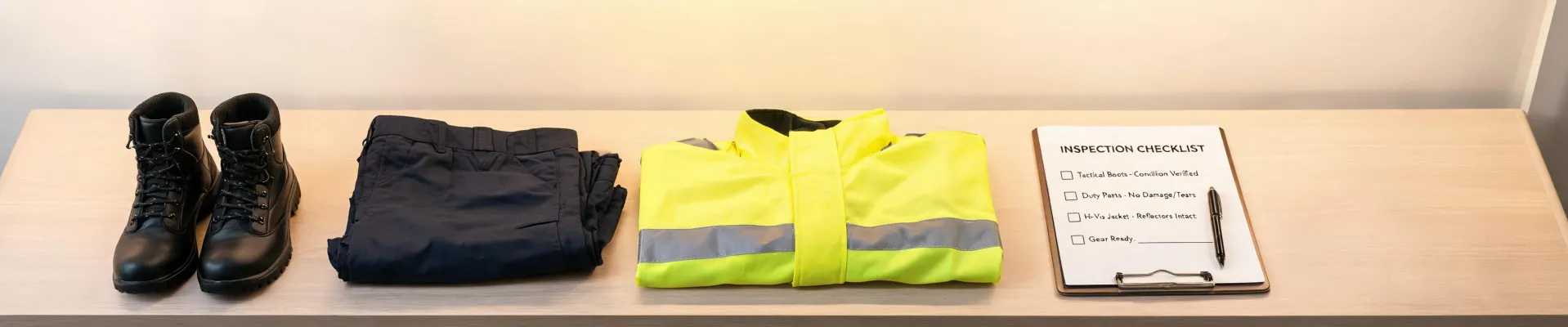
Procurement managers at 50-300 person companies who are about to refresh their PPE inventory — or who've watched a safety budget drift out of control for the third year running. I'm a procurement manager at a 180-person manufacturing company. I've managed our safety equipment budget ($240,000 annually) for 6 years, negotiated with 40+ vendors, and documented every order in our cost tracking system. This is the exact process I run. Seven steps. Two days of work. A track record of cutting budget overruns by roughly 23% since I formalized it in 2022.
No background section. No theory. Just the checklist.
Step 1: Start with the hazard assessment, not the catalog
You can't buy safety gear until you know what you're protecting against. OSHA requires a written hazard assessment (1910.132(d)) — and this is the part most buyers skip — it has to be updated whenever you change processes or equipment.
I still kick myself for the year I ordered 240 pairs of standard work boots because the catalog looked comprehensive. Then our welding team got a new plasma cutter, and we needed different boot specs. I ended up returning 60 pairs and absorbing a $1,800 restocking fee. Cheap mistake, expensive lesson.
So here's the actual step: print the hazard assessment, walk the floor with your safety coordinator, and list every hazard against ANSI/ISEA standards. Then — and only then — you buy.
Step 2: Don't let women's PPE become an afterthought
This is the step most procurement teams get wrong. For years, our female workers wore "small" men's boots that didn't fit right. About 40% of them complained of foot pain by the end of each quarter. We were buying men's sizes with a "women's" label slapped on.
The fix: source Red Wing safety shoes for women as a specific line item, not a colorway of the men's line. Red Wing offers women's-specific lasts (the foot shape the boot is built on) with narrower heels and specific width options — B, D, and sometimes EE. Price is roughly on par with men's: around $180-240 per pair at current pricing (verify current pricing at time of order). But the fit data matters more than the sticker.
In 2023, we tracked 60 women across three shifts. After switching to women's-specific Red Wing safety shoes, complaints dropped from 24 to 3 in a single quarter. Not the boot being "better." The boot being shaped right. Huge difference.
Step 3: Sample the oxford style for indoor-heavy roles
Not everyone needs a tall work boot. If your team spends most of its hours indoors — warehouse picking, light assembly, lab work — a Red Wing oxford safety shoe is worth a sample order. Lower cut, lighter weight, same toe protection (check ASTM F2413-18 for the specific rating).
Here's where TCO thinking matters. Oxfords often run $15-25 less per pair than their tall-boot equivalents, and workers wear them out at roughly the same rate on hard floors. On a 100-person crew, that's $1,500-2,500 annually before you even negotiate.
But sample first. We rolled out oxfords to our warehouse team without a trial in 2021. Three workers returned them inside two weeks because the lower cut didn't agree with their ankle support needs. Now we sample 5% of any new style before buying in bulk. It's a two-week delay. Worth every day.
Step 4: Take photochromic safety glasses seriously (and read the specs)
If your team moves between indoor and outdoor work, photochromic safety glasses — the lenses that darken in sunlight — are the ones that actually get worn. Standard clear glasses get left on a bench the moment someone walks outside. Tinted glasses get pushed up on the forehead indoors. Either way, workers are unprotected for 20-30% of the shift.
ANSI Z87.1-2020 is the standard to check. Not all photochromic glasses meet it for impact protection — some are just reading glasses with a tint. The good ones list Z87+ on the temple arm. If it doesn't say Z87+, put it back.
Expect $35-80 per pair depending on model and vendor (based on quotes from three PPE distributors in November 2024; verify current pricing). That's more than basic safety glasses ($5-12), and you'll need to justify it. The justification isn't comfort — it's compliance rate. Site observations showed a 60% jump in proper eyewear use after we switched to photochromic lenses in Q1 2024. Fewer eye injuries. Fewer incident reports. That math works.
Step 5: Put fire extinguisher service on a calendar, not a panic search
NFPA 10 requires monthly visual inspections and annual maintenance. It's easy to fall behind when "where to refill fire extinguisher near me" is a panic-search rather than a scheduled task on the shared calendar.
My rule: every extinguisher gets a refill or service date tied to the month it was last tagged. We use a shared calendar — nothing fancy — and I book the local service vendor for a single bulk visit annually. If you're searching "where to refill fire extinguisher near me" twice in one year, your system failed before it started.
Cost runs around $10-25 per extinguisher for basic service (verify with your vendor), plus a service visit fee. But the real savings show up elsewhere. Dodged a bullet in February 2024 when I checked the service log three days before a fire marshal spot check — two extinguishers were overdue. Caught it in time. Re-inspection fees in most jurisdictions run $150-400. The calendar is free.
Step 6: Audit the "other" categories with a spec sheet, not a search engine
Some products don't fit neatly into standard PPE catalogs. Our security team once needed handcuffs for a special event contract. The junior buyer's first move was to search "handcuffs near me" and buy from the first result. We ended up with a pair that didn't meet our insurance carrier's requirement for a double-lock mechanism. A $60 item that nearly cost us the contract.
For any non-standard category — handcuffs, restraint equipment, specialty welding gear — start with the requirement, then find a vendor who'll send a spec sheet. "Near me" is a distance filter, not a quality filter. Learned that one the hard way.
Step 7: Price the deadline, not just the item
This is the step that took me the longest to learn. After tracking six years of orders, I've come to believe that rush delivery fees are almost always cheaper than the cost of missing a deadline.
In March 2024, our fire extinguisher service vendor couldn't schedule annual maintenance until after a client site audit. We paid $400 for an expedited service visit. The alternative was a failed audit line item that would have cost us a $15,000 contract renewal. Not a close call — a rounding error.
But it's tempting to think you can just compare unit prices. The cheapest option isn't the one with the lowest sticker. It's the one that shows up when you said it would. I've been burned twice by "probably on time" promises. Now our policy is simple: if the deadline is fixed, we pay for guaranteed delivery and factor it into the bid rather than gambling on the timeline.
Three things that will trip you up
1. Sample first, always. A "standard" size isn't standard across lasts — even within one brand. We sample 5% of any new style before bulk ordering. It adds two weeks. It saves two months of returns.
2. Keep the spec sheet on file. When a worker gets hurt and the insurance carrier asks for documentation, "the catalog said it was safety-rated" isn't enough. Staple the ASTM or ANSI spec to your PO. Every time.
3. Don't let one vendor "just handle it." The moment a single supplier manages every category, you lose the pricing comparison that keeps everyone honest. We quote three vendors minimum for anything over $2,000 annually. No exceptions.
That's the checklist
Seven steps. Two days. A budget that stops surprising you.
The surprising part isn't the savings. It's how much of the job disappears once the process is written down. You stop re-deciding the same things. You stop paying for the same mistakes twice.