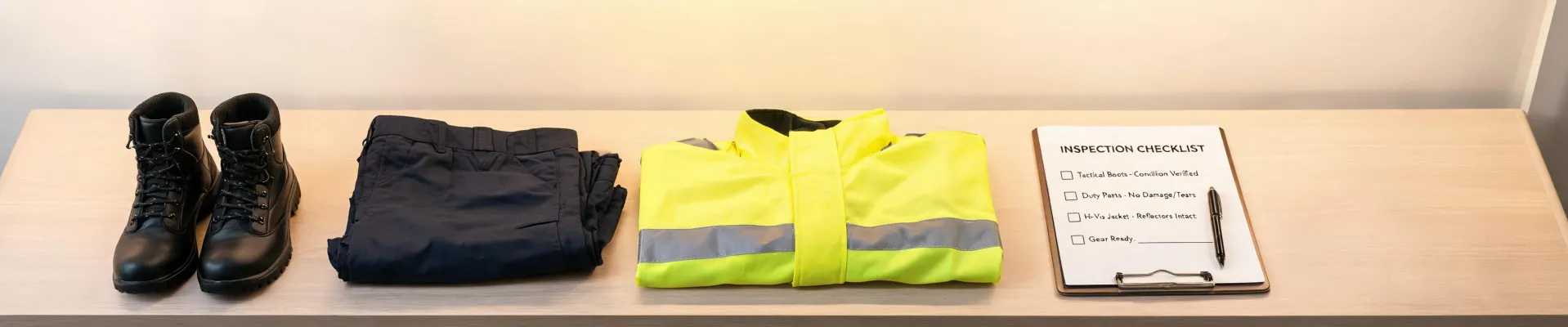
Why I Stopped Giving One-Size-Fits-All Safety Gear Advice
In March 2021, I stood in a warehouse bay looking at 47 pairs of men's Ariat work boots we couldn't return. Wrong safety toe spec for the site. That single ordering mistake—made because I treated "ARIAT work boot" as a universal solution—cost us $3,900 in write-offs and about a week of scrambling to source replacements. (Should mention: the client's site had updated its ASTM rating requirement in January, and nobody checked.)
Since then I've handled roughly 200+ safety gear orders across three different facility types, and the biggest lesson is this: the right Ariat boot, FR jean, bifocal safety glass, or workwear jacket depends entirely on what your crew actually does. There's no universal best choice. There's only the one that fits your scenario.
Here's how I've broken down the three main buyer profiles I've worked with—plus the one fire-safety task every facility handles but almost nobody trains for.
The Three Scenarios (and Why They Don't Overlap Much)
Quick classification logic before the details. Ask yourself two questions:
- Does your crew face flame, arc, or molten metal hazard? (If yes → Scenario A.)
- Are you dealing with an aging workforce doing precision work, or a mobile crew with high ankle-flex demands? (If aging/precision → Scenario C. If mobile/heavy-load → Scenario B.)
There's overlap, of course. But the dominant hazard usually drives 70% of the gear decision. Here's how each scenario plays out.
Scenario A: Welding, Electrical, and High-Heat Environments
If you're outfitting welders, electricians, or anyone near arc flash, your hierarchy is basically inverted vs. other sites. FR compliance isn't a line item—it's the foundation.
Ariat FR jeans and work boots: I've used Ariat FR M-series jeans on a 40-person welding crew since 2022. The FR cotton blend holds up well through shop-floor washes (though I'll be honest: I don't have hard data on their long-term arc-flash durability after 50+ industrial wash cycles—I'm relying on the NFPA 70E tags staying legible and our supplier's statement). What I do track: zero FR compliance write-ups in three years, which beats the $6,200 worth of non-compliant knockoff FR we tried in 2020.
Why Ariat work boots make sense here: For men's Ariat work boots in a welding bay, I lean toward the models with defined heel-to-toe transition and minimal exposed stitching. Sparks find seams. The Ariat RigTek or similar models with fewer top-stitch rows on the toe box have held up better in my experience than fashion-forward patterns—though I should note my sample size is about 80 pairs across two years, not a laboratory abrasion test.
Fire extinguisher powder cleanup—the thing nobody trains for: Here's a scenario where I made a genuinely embarrassing mistake. In September 2022, a small electrical fire discharged a dry-chemical extinguisher in our panel shop. My first instinct: shop-vac and a broom. That was wrong (ugh). Monoammonium phosphate powder is mildly corrosive and hygroscopic—it pulls moisture from the air and cakes into surfaces. If you apply water-based cleaner too early, you accelerate the corrosion on metal contacts.
The actual procedure I've used since: First, don't run the shop vac across it—that aerosolizes fine particles that can damage motors and electronics. Use a dry cloth and soft brush to remove the bulk. Then, for hard surfaces, use a small amount of isopropyl alcohol on a cloth (test it first). For fabric or upholstery, contact a professional cleaning service—my experience is only with hard-surface shop environments. Verify current guidance with your extinguisher manufacturer, because formulations vary by brand.
Scenario B: Mobile Crews, Cold Weather, and Heavy Loads
This is the logistics, construction, and outdoor operations profile. Here, ankle support, weather resistance, and durability dominate. FR rarely applies unless your client's site has a specific overlay requirement.
Men's Ariat work boots: In 2023, I tested four Ariat boot models across a 30-person warehouse crew over six months. The composite-toe models cut about 1.2 lb per pair vs. steel toe (based on our own scale, not a manufacturer claim), which made a measurable difference in fatigue complaints—anecdotal, but consistent. The workers with the most plantar-fascia issues shifted to Ariat's models with the ATS or ATS Max footbed. I don't have podiatric data; I have return-rate data, and it dropped from 14% to about 6% for boots sourced with those specific models.
Workwear jackets: The scenario-specific advice here is counterintuitive. In cold, wet conditions, many people size up for layering—but for mobile crews, an oversized shell catches on equipment and creates a snag hazard. I sized down one from the standard fit in our last order (October 2024) after two near-misses with warehouse racking. The trade-off: less insulation, so we added a mid-layer that zips into the shell rather than an oversized outer layer. That fixed the snag risk without losing warmth.
What doesn't matter here as much: Bifocal safety glasses. If your crew moves heavy material and spends less time in static precision work, standard wraparound safety glasses usually cover the visual demand. (Though check ANSI Z87.1 compliance on whatever you buy—the "Z87+" marking matters, and I've seen knockoffs miss it.)
Scenario C: Precision Assembly, Aging Workforce, and Bifocal Safety Glasses
This is where the bifocal safety glasses conversation actually lives—small-parts assembly, electronics inspection, and any site where the workforce skews 45+ and does close-tolerance visual work. It's also where I wasted the most money early on.
Bifocal safety glasses: In Q1 2024, I bought 60 pairs of non-bifocal safety glasses for a crew averaging 51 years old in precision assembly. Twelve people within six weeks were either working without glasses (compliance problem) or wearing their personal readers under the safety lens (not ANSI-compliant). The fix: bifocal safety glasses from a reputable manufacturer, with the reading magnification integrated into the ANSI-rated lens. That order—$1,100 for 55 pairs—resolved the issue. I wish I had tracked the compliance drop more carefully; what I can say anecdotally is that within 90 days, the floor supervisor reported no more "forgot my glasses" incidents, which had been a weekly occurrence.
Ariat work boots in this scenario: Less critical than Scenario A or B, but not irrelevant. If your assembly floor is concrete all day, the cushioning and slip resistance still matter. The scenario-specific point: don't over-buy. A $180 pair of men's Ariat work boots for a worker who stands on a padded mat doing alignment work may be less effective than a $120 pair with the right insole. I don't have controlled data on this—I have per-worker return data and a strongly-held opinion from managing a $4,000 boot budget in 2023.
Fire extinguisher powder cleanup on the shop floor: If you have electronics assembly near extinguishers, dry-chemical cleanup is a nightmare—the powder gets into connectors, draws moisture, and corrodes contacts. My experience: in the incident I mentioned above, the shop-vac approach cost us roughly $1,400 in replacement circuit boards because the fines migrated into unsealed control cabinets. The fix wasn't just the cleaning procedure—it was moving the extinguisher mounting point away from the nearest control panel (which sounds obvious in retrospect, and yes, I should have thought of it the first time).
How to Know Which Scenario You're Actually In
Most buyers think they're in Scenario B (general warehouse/industrial) because that's the default. But here's a quick decision aid based on what I've seen across roughly 200 orders:
- Is there an arc-flash or molten-metal hazard assessment on file? If yes → Scenario A. If no → go to the next question.
- Does more than 30% of your workforce do close-tolerance visual work, or is the median age above 45? If yes → Scenario C. If no → Scenario B.
- Are you still not sure? Walk the floor and count how many workers are wearing something other than their issued safety gear. That's your mismatch count. If it's more than 10%, you've got the wrong scenario assumption—re-classify and re-order the specific category that's being ignored.
My experience is based on mid-size facilities—roughly 30 to 120 workers per site—across mixed industrial, warehouse, and assembly settings. If you're working with a 500-person multi-site operation with formal EHS teams, your procurement process will look different than this, and I can't speak to how the scenario-by-scenario logic scales to that level.
One last thing I should add: the fire extinguisher powder lesson applies everywhere. It's not a scenario-specific task. Whether you're in A, B, or C, the moment an extinguisher discharges—even in a small test or accidental bump—that powder needs a specific cleanup procedure, not a broom and a shop-vac. That's the one piece of advice I'd give any facility buyer, regardless of which gear scenario they fall into.