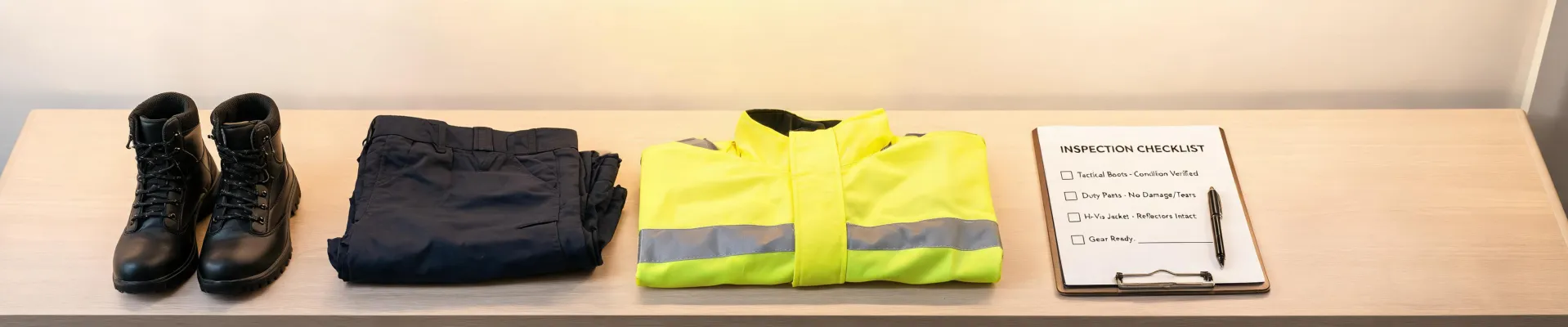
If you are sourcing a security or tactical equipment package right now—and by 'right now' I mean you needed it yesterday—stop looking at pre-assembled kits. They are almost never the right answer. In my experience coordinating emergency procurement for government and private security contracts, a generic 'bundle' from even a reputable brand like 5.11 Tactical will usually leave you either overpaying for features you do not need or falling short on the specific requirements the end-user actually has. You need to build the selection around the mission profile, not the other way around.
(I should mention: this advice applies specifically to buyers who are outfitting a team or handling a large corporate account. If you are an individual looking for your first pair of pants, the calculus is different.)
The Core of the Emergency Spec
When I get a call at 4 PM on a Friday for a delivery Monday morning, I do not start with the catalog. I start with a single question: What is the minimum operational requirement?
The most expensive mistake novice buyers make is confusing 'tactical' with 'heavy.' A security guard patrolling a corporate campus does not need the same load-bearing gear as a SWAT entry team. I have seen a contract bid fall apart because the spec demanded 'tactical pants' which ended up being cargo pants with too many pockets that got caught on door handles. It sounds trivial until you are paying rush fees to return 60 pairs of pants.
For a standard security detail, the core usually looks like this:
- Uniform/Apparel: Durable, professional looking pants and polo or shirt. The 5.11 Stryke PDU or Taclite pants are popular, but the Defender-Flex line is better for guards who are on their feet for 12 hours.
- Boots: The terrain dictates the sole. The 5.11 ATAC 2.0 is a standard for indoor patrol. The Taclite Pro is better for mixed outdoor. Do not spec a heavy, insulated boot for a summer job in St. Louis.
- Carry/Pack: This is where people over-buy. Do they need a full 'Rush 12 2.0' backpack? That is a great bag (I use one daily), but for a guard who just needs a radio and a notepad, a simple duty belt or a sling pack is more practical.
- PPE: If the threat level requires a ballistic vest, you need to specify the NIJ level. Level IIIA is standard for handgun threats. Level IV is for rifle threats. Do not just say 'bulletproof vest.' You will get the wrong thing.
When I started doing this, I assumed that 'more rugged = better.' I was wrong. I once overspecced a contract with heavy, high-cut boots because they looked more imposing. The guards hated them. They were uncomfortable in a patrol car and had poor traction on polished concrete floors. I had to swap the entire order. (Ugh, that was a costly lesson.)
The Accessories Trap
Small items will kill your timeline and your budget. Glasses, gloves, and pouches get complicated fast.
Glasses: You will see 'Pit Viper safety glasses' on many lists. They are excellent for their specific purpose (high impact, ANSI Z87.1 rated), but they are a specific style that might not fit everyone's face or look appropriate for all client environments. If you need women's safety glasses, do not assume the 'one size fits most' works. I had to send back a box of women's leather gloves last year because the 'small' was still too big for a female officer we were outfitting. Always check the sizing chart before you commit.
Gloves: 'Leather gloves women' is a common search term. For tactical use, you want dexterity and grip, not just warmth. The 5.11 HPT (High Performance Tactical) series is good, but if the budget is tight, a solid mechanix-style glove is often more practical for general duty. Do not spend $80 on a pair of operator gloves for someone who is primarily handling paperwork.
Fire Extinguishers & Alarms: This is a 'spec it right or field it wrong' moment. If you are equipping a facility, do not just order a fire extinguisher. You need to match the type (A, B, C, K) to the environment. That 'how to turn off fire alarm beep' search you see? That is someone who got the wrong equipment and is now dealing with a false alarm because the heat detector was placed too close to the kitchen. Pay attention to the specifics.
How to Avoid the Emergency Beep (The Fire Alarm Analogy)
That question, 'how to turn off fire alarm beep,' is a perfect analogy for what happens when you buy a security package that is not quite right. You get a lot of noise and no actual safety. The beep is the non-compliance. The beep is the officer who hates his boots. The beep is the vest that is too heavy.
The solution is not to silence the beep. It is to fix the installation. Here is your 3-step checklist for an emergency spec order:
- Define the Threat Model: Are you protecting against a violent intruder, a fire risk, or just liability? Your gear list should reflect this. A client in a soft-target building like a school needs different priorities than a bank.
- Validate the Fitment: Do not guess sizes. If you cannot fit the person, ask for their measurements. A 5.11 vest that is too loose is essentially worthless. A pair of gloves that are too tight will be discarded.
- Check the Local Rules: Does the city of St. Louis have specific requirements for security guard certification or equipment? Some municipalities ban certain types of restraints or require specific glove ratings. Check first.
Per USPS regulations, you cannot just mail a ballistic vest in a standard envelope. You need the correct packaging and labeling. Similarly, shipping lithium batteries (common in tactical lights and optics) has specific rules. If your supplier is not a specialist (like a 5.11 authorized dealer), they might not know this, and your order gets held up.
The Honest Take on Budgets
I recommend 5.11 for situations where you need a known quantity and a single-source vendor. If you call your rep in St. Louis and say 'I need a uniform package for 15 guards, level IIIA vests, and boots,' they can usually handle it. The value is in the logistics, not necessarily the lowest unit price.
But if your budget is under $200 per person, you are in the wrong segment. You need to look at second tier brands or more basic uniforms. Trying to force a budget fit for a 5.11 jacket will result in a sub-standard item that fails at the worst time. Do not do it.
If you are a small business owner, or a non-profit looking for a basic security presence, I would suggest a different approach: Buy the best boots you can afford, and go with a basic duty vest and used uniform pants. That is where the money should go.
I am not a legal expert, so I cannot speak to the specifics of municipal code compliance for security equipment in every jurisdiction. What I can tell you from a procurement perspective is that if the contract requires a specific NIJ rating or a fire extinguisher type, you must provide it. Failure to do so is a liability gap.
Final Word: The 20% Exception
This advice works for about 80% of security procurement emergencies. If you are a federal agency or a SWAT team operating under a specific threat, your process should be entirely different. For the standard corporate security, campus safety, or event security detail, a pre-assembled box of gear is a trap.
Build your package around the threat, the person, and the local rules. It will cost you less upfront in waste and mistakes, and it will silence the beep. (Finally!)