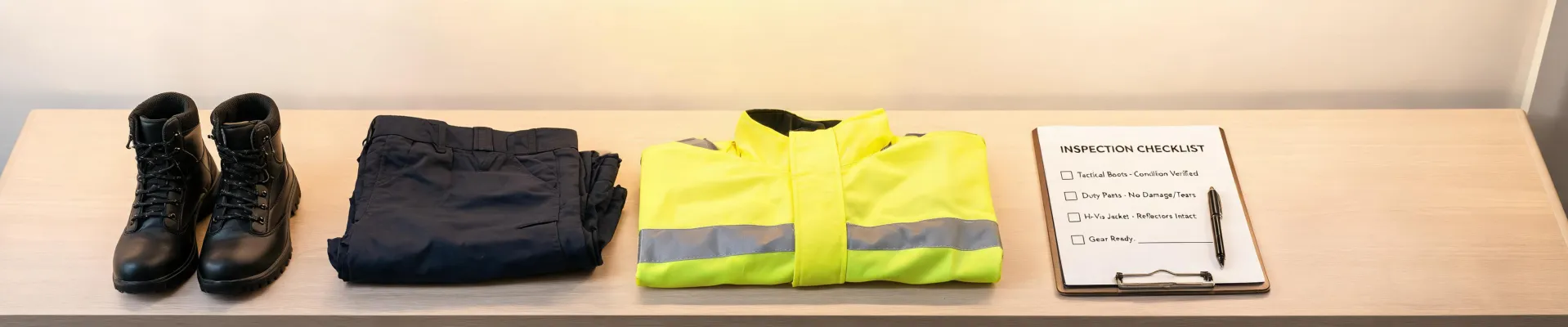
Most people in safety procurement are leaving money on the table.
I'm not talking about a few bucks here and there. I'm talking about 15-20% of your annual budget, wasted on things that simply don't need to cost that much. As the guy who's managed our company's tactical gear budget for the last 6 years—around $180,000 in cumulative spending—I've made enough mistakes to know what actually works.
Here's the thing: the problem isn't that gear is expensive. The problem is how we buy it.
The biggest trap: Buying by line item instead of by lifecycle
When I first took over our procurement, I did what most people do: I found the cheapest price for each item on our list. A pair of tactical pants here, a flashlight there, some safety glasses from another vendor. Looked great on the spreadsheet. Total line-item cost was way down.
Turns out, that's exactly the wrong approach.
Let me give you a concrete example from my own records
Back in Q2 2023, I compared costs across 4 vendors for a standard order of 50 sets of PPE (gloves, helmets, safety glasses, and boots). Vendor A quoted $8,200. Vendor B quoted $6,900. I almost went with B until I calculated the total cost of ownership (TCO).
Vendor B charged $350 for shipping on that order. Their return policy was limited—if gear didn't fit, we'd eat the cost. Their 'standard' boots had a 6-month warranty compared to Vendor A's 18 months. When I added it all up over a 2-year lifecycle? Vendor A was actually 12% cheaper than Vendor B. That's a massive difference hidden in fine print.
I've seen this pattern many times. It's not malicious—most vendors aren't trying to trick you. But the assumption that 'lowest price = best value' is one of those common myths that costs organizations real money.
Three specific areas where tactical gear procurement goes wrong
1. Boots and apparel: The 'cheap pair' fallacy
People think buying a $90 pair of tactical boots saves money over a $160 pair. They're wrong—but not for the reason you'd expect.
The $90 boots last maybe 8-10 months in field use. The $160 boots? I've tracked them lasting 22-26 months in the same conditions. That's not a 40% price difference—that's a 60% cost per wear-month difference in favor of the more expensive boot. I've got the spreadsheets to prove it.
This is true across apparel: the $35 tactical pants that fray after 6 washes vs. the $65 pants from 5.11-tactical that hold up for 2+ years. The initial purchase price is irrelevant. Total cost per mission-hour is what matters.
2. Safety glasses: Don't buy cheap optics
This one surprised me. I figured safety glasses were safety glasses—as long as they met ANSI Z87.1, we were good. So we bought the $12 pairs in bulk. Looked like smart procurement.
Then I started tracking the 'replacement rate'—how many pairs needed replacing per quarter due to scratches, fogging, or breakage. The cheap glasses had a replacement rate 4x higher than the mid-tier options. And the mid-tier options? 5.11 tactical light glasses, the heat wave safety glasses with anti-fog coating—they cost $35 but lasted literally 3x longer.
The total cost analysis was clear: cheap glasses cost us more per year than quality ones did.
3. Flashlights and tools: The 'I'll just get a multi-tool' mistake
I see this all the time. Someone needs to open a padlock without a key, or cut a zip tie, and they grab whatever's cheapest. Then they're replacing it every 3 months.
A $25 multi-tool seems like a no-brainer until you realize you've bought 6 of them over 18 months. A $100 tactical light from a reputable brand? One purchase, one warranty, one line item. That's not more expensive. That's cheaper.
The same logic applies to any tool your team uses regularly. Buy once, cry once. The crying lasts about 30 seconds. The savings last for years.
Responding to the inevitable pushback
I know what some of you are thinking: 'We can't spend that much upfront. Our budget is fixed.'
I've heard that. I used to say it myself. But here's the reality: a fixed budget doesn't mean fixed purchasing decisions. It means you have to optimize within constraints.
If you have a $10,000 annual budget for tactical apparel, you can either:
- Option A: Buy 120 pairs of $80 pants, replacing 60% of them within the year
- Option B: Buy 80 pairs of $120 pants, replacing 15% within the year
In Option B, your team ends the year with better gear on their feet and fewer complaints. The per-person cost is lower. And you've saved the time spent processing replacement orders. That's not hypothetical—I calculated this exact scenario in 2023.
The bottom line: Stop optimizing for the purchase price
I've never fully understood why procurement departments default to 'cheapest line item.' My best guess is it's a holdover from an era when everything was simpler and product lifespans were more predictable. That era is over.
An informed customer—one who understands total cost of ownership, who tracks replacement rates, who evaluates vendors on lifecycle cost rather than unit price—makes better decisions. And better decisions save money. Real money.
Stop buying gear. Start buying solutions that last. Your budget—and your team—will thank you.
This analysis was based on procurement data from Q1 2022 through Q4 2024. Pricing and product availability may have changed since then. Always verify current rates and warranty terms before committing to a vendor.